Sunday, August 26, 2012

Ancient Artifacts: The Penn Museum Online Exhibits

The Penn Museum, which is a part of the University of Pennsylvania's campus, is one of those dusty old museums that contain some really interesting hidden gems.  How much you enjoy the museum depends on your level of patience - are you willing to shuffle through display cases that haven't changed much in fifty years?  If not, you might dismiss this as just another dry scholar's museum.  But if you do take the time to look closely at everything, you might find yourself pleasantly surprised.  The museum is now trying to show the world how interesting it can be through a few online exhibits, though I'm not sure how well they're succeeding.
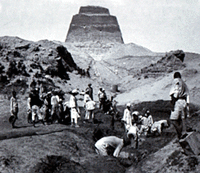
There are ten exhibits you can browse on the Penn Museum's website, but for some reason the presentation of these exhibits isn't at all consistent.  The best allow for 3D viewing of objects in the collection and the exhibit halls they reside in.  Some also have interactive maps showing where University of Pennsylvania teams unearthed featured artifacts.  And some do a good job of linking the objects shown in these exhibits to the content of the physical museum's permanent displays.

But these positive aspects really only hold true for three exhibits:  The Real Story of the Ancient Olympic Games, The Ancient Greek World, and Egypt:  A New Look at an Ancient Culture.  The other seven exhibits leave something to be desired.  They tend to be long-winded, featuring long blocks of text interrupted only by a sparse few images.  Some take a rather too familiar tone, using a voice that seems much too casual and colloquial for exhibit content.  And one exhibit, The Real Me:  Therapeutic Narrative in Cosmetic Surgery, read like a very long Vanity Fair article slapped up on the web in a tiny blue font.

Over all, the online exhibits are pretty disappointing.  Compared to other physical museums that put content on their website, the Penn Museum is sorely lacking.  It seems strange that such a well-respected museum would neglect consistency and the curatorial voice, not to mention an element of enjoyability, in their online museum presence.  I do hope they get around to sprucing up this content, and soon, or they risk coming off as just another stuffy university museum.


The Penn Museum Online Exhibitions
Website:  www.penn.museum/online-exhibits.html

Sunday, August 19, 2012

Remembrance: The United States Holocaust Memorial Museum Online Exhibitions

That most of us have learned about the Holocaust, in school and through our families and possibly our religious institutions, is testament is how hard we have worked to ensure that the horrors of this mass persecution aren't ever repeated.  By teaching each other about this tragedy and the awful acts that were committed, we hope to make such violence and prejudice repellent.  That's the aim of the United States Holocaust Memorial Museum, and now through its online exhibits anyone can learn, in depth, the many different aspects of this genocide.

The Holocaust usually conjures up images of Jews being persecuted, which was its primary intention - but it's easy to forget that there were many other facets of the German rise to power.  The Holocaust Museum's multitude of online exhibits cover, basically, everything.  Want to know about the 1936 Berlin Olympics?  There's a huge exhibit about that event.  Curious about survivors who continued their lives in the United States?  You can view many oral histories about this migration.  You can also learn about religious leaders who opposed the German government, Nazi propaganda and Holocaust denial.

Some of these exhibits are highly detailed - the one about the Olympics, for example, goes on for pages and covers just about everything you could possibly think of.  Some are just a few short paragraphs, like the page about people of African descent in Nazi Germany.  This inconsistency is a little annoying, because you don't know if you're going to get a avalanche of information and photos or just a few bits of information.  I was also frustrated by the setup of the online exhibitions, because if you got caught down the rabbit hole of a particularly detailed exhibit, it was difficult to get back to the main page displaying all of the exhibits.

But the online exhibits do plenty of things incredibly well.  There are a wealth of images, video, and oral histories to browse through.  The museum also lets you browse its ID program (which presents photos and histories of specific concentration camp victims) online.  Plus, the shear number of topics is really amazing because it reminds you just how devastating the Holocaust was to so many groups of people.  It's this type of presentation and remembrance that helps us keep in mind how devastating this period in history was, and why we should never forget it.


The United States Holocaust Memorial Museum Online Exhibits
Website:  www.ushmm.org/museum/exhibit/online


Sunday, August 12, 2012

Almost There: Smithsonian National Museum of Natural History Panoramic Virtual Tour

The Smithsonian museum system is, in my opinion, one of America's national treasures.  Comprising nineteen separate institutions plus a zoo and nine research centers, its collections are magnificent and highly varied.  And because it's run by the federal government, you can visit any part of it for free.  But if you've never made the trek to Washington, DC (or if you went there but somehow managed to not go to any part of the Smithsonian), you might never get a chance to see any of this.  But fear not, because the National Museum of Natural History (NMNH) now has a virtual tour you can access from the comfort of your own home.

The NMNH's tour is pretty impressive.  You start in the building's rotunda and are treated to a lifelike 3D panoramic view of what's inside.  From there you can move around to all the exhibits - nineteen in total - via hotspots marked as arrows.  Clicking these arrows will take you from one gallery to the next, and in each section you can zoom in or out, rotate, and move up or down.  Galleries can also be accessed on a map in the upper right-hand corner of the screen, where the hotspots are labeled and clickable.

This setup is fascinating, because it really is the next best thing to actually being there.  The dioramas, the artifacts, the taxidermied animals - each of them is right in front of you in all their magnificence.  At some of the exhibits, you can even click on a camera symbol to get a close-up view of a particular specimen.  And since this is a virtual tour, you can spend as long as you like looking at everything, without the crowds and noise of a real museum.  The NMNH has even put several past exhibits online, plus a few views of the museum's grounds.

The only thing I found frustrating was the lack of interpretation on the tour.  In theory, you could zoom in on any of the information panels in the gallery until they were legible.  But in reality, only about half the panels were photographed in a resolution that allowed you to read them.  And those that are clear enough to make out distinct words can be difficult to view - you have to navigate precisely, so that the text comes into your field of vision, and you can easily bypass them if you don't look hard enough.

It would be nice to have information about what's in the galleries readily available - that would probably make this virtual tour perfect.  But even though that's not currently available, I still have to recommend the NMNH's panoramic tour as one of the best virtual museum projects I've seen.  It's made from pretty advanced technology, but it's not full of bells and whistles and gimmicks that take away from the museum's purpose.  It simply recreates the experience of browsing through the museum and seeing its many wonderful objects.


Smithsonian National Museum of Natural History Panoramic Virtual Tour
Website:  www.mnh.si.edu/panoramas

Sunday, July 8, 2012

From Sea to Shining Sea: National Park Service Virtual Museum Exhibits

I grew up in a family that loves the U.S. National Park system, so I've had the chance to visit many parks, monuments,  and historic sites.  These places are interesting and definitely teach you a lot about American history and the natural wonders of the United States, but they can also be very remote.  Luckily, if you want to visit one of these sites but don't have time to travel, the Park Service's Virtual Museum Exhibits can bring the parks to your computer.

So far, only a handful of sites have any sort of online exhibit presence, so you might not get to learn about a site you're most interested in.  The sites that are online display pictures of artifacts they have, along with interpretive texts and maps.  All pictures can be viewed in detail, and in some cases the site provides links for you to request a copy of the image.  A few sites, mostly ones based around outdoor scenery and natural formations, also offer video.

But while it's certainly interesting to see historical artifacts and learn about, say, civil war battles and Native American culture, it can quickly get boring just reading and looking.  This format might hold up for really engaging sites like Alcatraz, but I'm convinced that only the most die-hard presidential history buff wants to scroll through pages and pages of text on Harry Truman.

Dinosaur National Monument is the only site to offer truly interactive features in its virtual exhibits.  On their website you can see a movie about the monument, view a 3D dinosaur skull from different angles, and take a virtual tour of an artist's depiction of the prehistoric West.  Features like these help keep a visitor's interest, and it would be great if other sites could incorporate something similar into their online exhibits.

It's definitely worthwhile for these few sites to have an online presence where they can display artifacts, images and information.  The Park Service is a treasure, in my opinion, and is unknown and underutilized by too many people.  But virtual exhibits don't have to be so static - after all, what's contained at these sites is pretty amazing, and visitors should be able to grasp that.  I wish that more sites would display exhibits online - exhibits that are fun and engaging for all kinds of visitors.


National Park Service Virtual Museum Exhibits
Website:  www.nps.gov/museum

Wednesday, July 4, 2012

California Dreamin': The Sierra Nevada Virtual Museum

California may be the biggest state in the U.S., but there are still 274 million Americans who live in some other state or territory.  For many people who grew up elsewhere (including myself), California can seem like a distant, glamorous paradise filled with beautiful people and all kinds of different landscapes.  Other places on the internet can help you find the Golden State's crop of celebrities, but if you're instead interested in the scenery, I can recommend the Sierra Nevada Virtual Museum for browsing and learning.

The sheer amount of information located in this museum is astounding.  You can learn about the art, literature, history, geology, ecology and topography of the area surrounding this mountain range, and also delve into the life stories of notable residents.  Almost every section has accompanying text, and those that don't have are interpreted by videos that combine images and audio clips (either from experts or from the time period being described).  You can also view art, nature photographs (I really liked seeing local petroglyphs), excepts from writings, and interactive maps.

What I especially enjoyed was the Virtual Field Trips, which use narrated video to explore well-known points of interest in the Sierra Nevada (like Yosemite Park and the Pacific Crest Trail).  I like that the museum really tries to bring nature to visitors, and that this section is presented as a series of field trips.  This really helps in bringing the museum's mission to the visitor and replicating a physical museum experience in an appropriate virtual format.

The one thing I didn't like about this museum is their over-reliance on film and animation.  It's great to include some video in the exhibits to keep visitors' attention, but it becomes a little overwhelming when nearly everything moves and plays music.  A few too many sections of the museum have both video and text, which becomes a little too much to take in after a while.  You should know that if you're using a raccoon with an annoying voice to introduce videos, you've gone overboard.

But aside from this one flaw, the museum is a pretty good example of what can be accomplished through a virtual museum.  You might never think of talking about and displaying nature on a computer screen, and yet this museum does it well.  By using a multimedia approach, and covering lots of ground in a mostly engaging manner, the Sierra Nevada Virtual Museum really does bring California into your home.  It's the next best thing to being there.


Sierra Nevada Virtual Museum
Mission:  Sierra Nevada Virtual Museum is a multimedia, interactive online museum the rich history, culture, and natural history of the Sierra Nevada.
Website:  www.sierranevadavirtualmuseum.com

Sunday, June 17, 2012

Friendly Skies: The Aviation History Online Museum

I've been to Kitty Hawk to see the Wright Brothers' airplane models.  I also went to Arctic Thunder 2010, a daylong air show at Elmendorf Air Force Base in Anchorage.  Beyond that, my knowledge of air transportation is limited.  So I was glad to find the Aviation History Online Museum because, at least in some cases, it provides a lot of interesting and engaging information.

The best part of this museum is its Aircraft gallery, which lists many different airplane models (alphabetized by manufacturer).  For almost every model, you can view photos and a few short paragraphs of information.  You also have the option to see a much longer and more technically detailed history of the aircraft.  I love the way this is set up with two different levels of information because visitors who are really into aviation will be curious enough to read the longer texts, while those who are novices will find the shorter interpretation to be a good introduction.

I also really like the Early Years section, which details all the different inventors whose ideas led up to the first airplane.  The information here is truly interesting and not overly long, and it's presented in a way that lets you see how each person piggybacked off previous discoveries.  The Theory section also does a good job of taking difficult scientific concepts and explaining them for visitors to understand.  There's also a nice selection of videos that show clips of the Battle of Okinawa, the history of TWA, and many other relevant subjects.

There are a few sections that might be tough for the average visitor to get through, like the series of articles posted to the museum.  They're long and too much like Wikipedia, and I imagine that only the nerdiest of aircraft enthusiasts would find them interesting.  The same is true for the section on engines and, disappointingly, the gallery featuring famous aviators.

All in all, though, this is an unexpectedly engaging museum.  It makes aircraft and the history of flight fun and accessible to visitors of all interest levels.  There's a lot of pictures and simple explanations for those of us who have never considered why we fly, and there's also plenty of technical information for airplane enthusists.  I would recommend this museum to anyone, because I guarantee you'll learn something and maybe even become more interested in flying.


The Aviation History Online Museum
Website:  www.aviation-history.com

Sunday, June 10, 2012

As Rome Goes: The Ostia Virtual Museum

Roman art and architecture is beautiful, even if most of it is now crumbling.  But since many people haven't had the chance to visit Italy's historical sites (I've only ever been to Rome's airport), we have to rely on images of the these ancient splendors.  That's the function of the Ostia Virtual Museum, which is dedicated to displaying ruins and unearthed artifacts from this port within the Roman empire.

The breadth of objects you can view at this museum is impressive - the images are organized by medium, so you can view things made of glass, metal, terra cotta, bone and marble, as well as mosaics, stucco reliefs, fading paintings and what's left of ancient buildings.  The images are of varying quality (only some are in color, and most were taken pre-digital camera) but almost every piece has been photographed at various angles, so you can still get a good sense of what each looks like.

The text accompanying the images is better than many other virtual museums I've encountered, but not perfect.  In many cases detailed information is provided about where the object was found and what is depicted, and where there are black-and-white photographs some effort is made to describe the true colors.  It would be nice to know about how old everything is (if ages are indeed known), but more importantly I would like to know just how each piece fits into the Rome's story and culture.

This, I think, is the biggest flaw in the museum:  there is not enough historical context.  From just browsing the museum's website, I got the impression that Ostia was a coastal city somewhere in Italy.  It took a visit to Wikipedia to learn that Ostia is in fact a part of the city of Rome, and was a popular place for Romans to vacation in the summer.  This is information that should be readily available throughout the museum, along with explanations of why the art and architecture mattered in that time.  If you were unfamiliar with Roman mythology, for example, a lot of the art might seem confusing, and the museum provides no way to help understand the depictions and symbolism.

I don't want this criticism to detract from the greatness of this museum, because it's definitely worth a look if you're at all interested in seeing how the ancients lived.  If you like Rome, old things, or seeing well-known myths illustrated, there's plenty to view here.  For a novice, though, this museum could seem stuffy and intimidating.  A little more information here could go a long way.


The Ostia Virtual Museum
Website:  www.ostia-antica.org/vmuseum/vmuseum.htm